
Most companies stall after the pilot. Here is a practical framework, from workforce proficiency to workflow automation to business reinvention, that compounds gains quarter over quarter.
Every company has a handful of people experimenting with AI. A few prompt-curious engineers, a product manager who drafts specs with ChatGPT, a sales lead who uses it for outreach. But scattered individual adoption is not organizational readiness. The gap between "some people use AI" and "AI makes this company measurably more effective" is where most organizations stall, and it's a gap that widens the longer it goes unmanaged.
The blueprint that follows is a starting architecture: three interlocking phases that can be tailored to a company's size, maturity, and competitive urgency. The specific sequence matters less than the underlying logic: you build proficiency before you automate, and you automate before you reinvent.
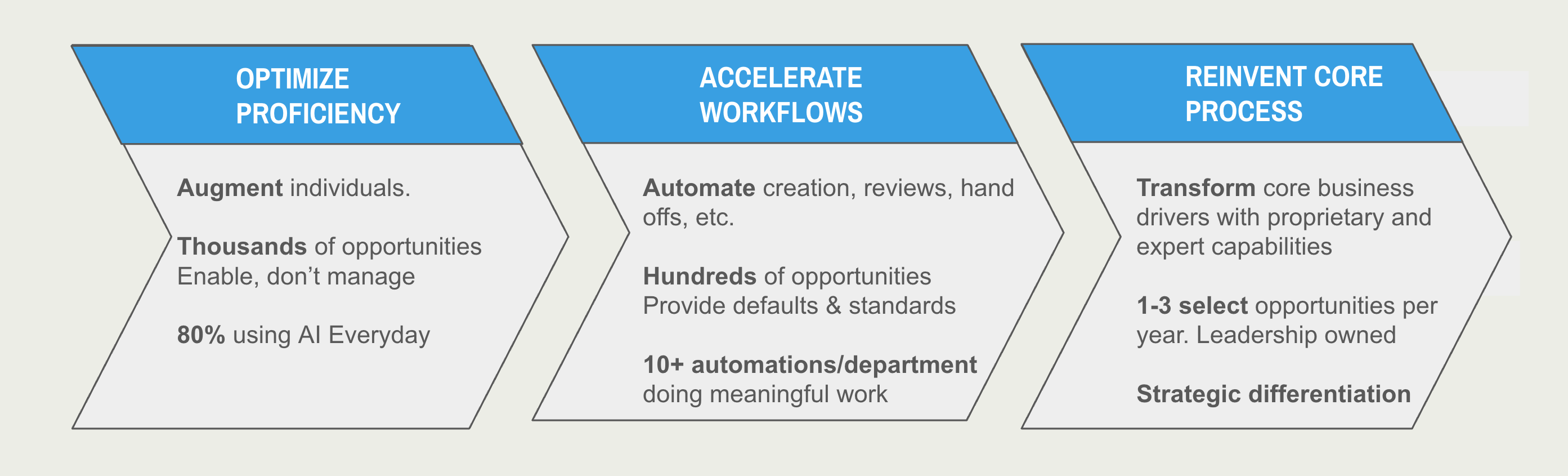
Phase One: Optimize. Build Workforce Proficiency
The first phase targets the simplest and most measurable goal: get 80% of desk workers using AI tools daily. As a routine part of how they work, the way they already use email or Slack. This sounds modest, but most organizations are nowhere close. Many workers still lack tool access, aren't sure what's available, or have tried a chatbot once and written it off.
The enabling actions follow a lightweight change management cadence: share the vision and create room to evolve, ensure everyone has access to capable tools, train on basic proficiency and coach on role-specific use cases, activate leaders and champions at every level, and establish regular touchpoints (hackathons, office hours, lunch-and-learns, story sharing) that make AI experimentation visible and social. The math at this stage is straightforward: 80% daily active users multiplied by a conservative 10-20% individual productivity gain yields 10-16% of total workforce capacity reclaimed.
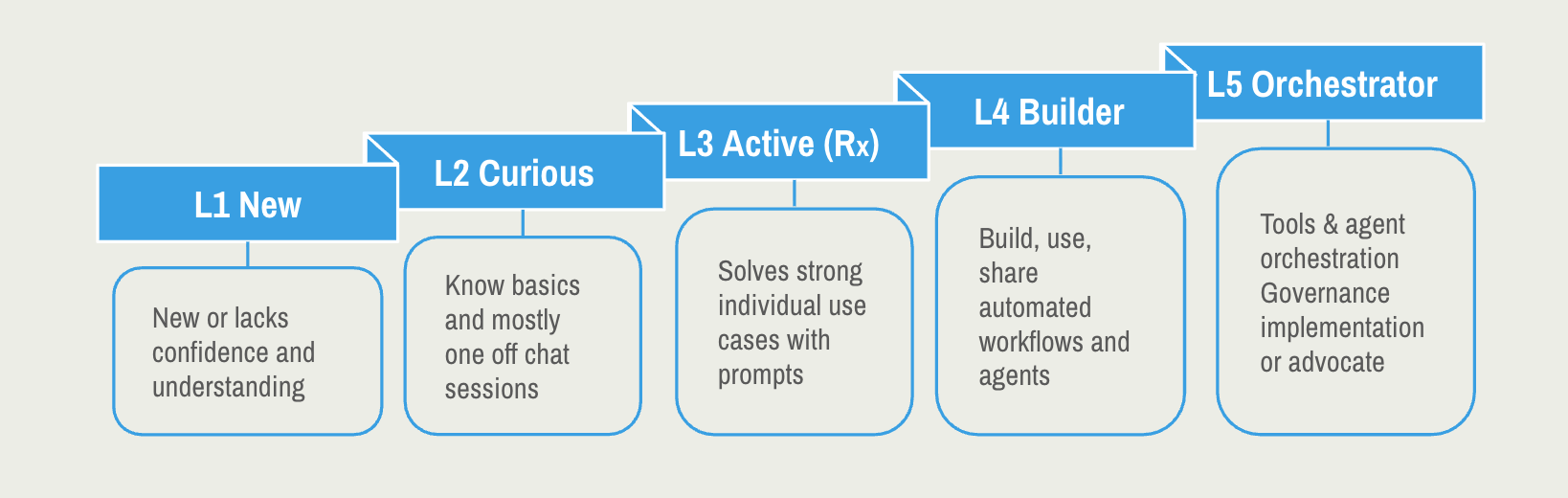
Proficiency itself has levels. An L1 worker is new to AI tools and rarely uses them. An L2 is curious but uses AI as a search replacement: single prompts, shallow interactions. L3 is the inflection point: workers with strong individual use cases who iterate on prompts and apply AI to real work consistently. L4 workers are building and sharing automated workflows. L5 is full agent orchestration: designing governance, shaping how AI reshapes their role. The initial target is getting 80% of the workforce to at least L3. That's when the compound effects begin.
Phase Two: Accelerate. Automate Workflows
Once proficiency reaches critical mass, the opportunity shifts from individual productivity to team-level automation. The target here is concrete: at least one meaningful agentic augmentation running with consistent weekly usage in every business function: sales, legal, marketing, finance, HR, ops, product.
These aren't science projects. They're workflows that reclaim real hours: sales teams responding to leads faster with personalized outreach, legal producing first drafts in minutes instead of days, product teams running user research at twice the cadence, account management achieving higher RFP win rates. The ROI arithmetic compounds quickly. 100 automations across the organization, each saving two to four hours per cycle, yields 200 to 400 hours reclaimed. But the real value is the organizational muscle that develops: teams learn to identify automation candidates, define success criteria before deploying, run build-measure-learn cycles against baselines, and report results at 30/60/90-day intervals.
Critical to this phase is clear ownership. Each automation needs a responsible owner, centrally governed or departmentally owned depending on company size. Every small team should have a champion: someone who experiments with new tools, attends cross-functional champion sessions, and reports back. Agentic automation will become an essential skill for most knowledge workers, and the champions are how that capability propagates.
Phase Three: Reinvent. Transform Core Processes
The third phase is where the real strategic differentiation happens, and where the risk is highest. This phase goes beyond doing existing work faster. The goal is using AI to power one to three core business drivers: the processes that define how the company competes. Expert capabilities like co-scientist or co-strategist roles. Distribution and conversion systems. Process re-engineering that compresses cycle times. Software systems management that enforces controls, compliance, and consistency at scale.
Not every company reaches this phase at the same speed, and the specific reinventions vary by industry and strategy. But the pattern holds: the proficiency built in Phase One and the automation muscle built in Phase Two are prerequisites. Companies that try to jump straight to reinvention without the organizational fabric to support it end up with expensive pilots that never scale.
The Compounding Logic
What makes this framework work is the compounding relationship between phases. Proficient workers identify better automation candidates. Running automations surfaces opportunities for deeper process transformation. Each phase funds the next: reclaimed hours become the investment capital for the subsequent stage. The 18-month timeline is a rhythm: optimize, accelerate, reinvent, and the organization gets measurably more effective with each cycle.